The Ocean’s Greatest Musician
The Humpback Whale (Megaptera novaeangliae) produces the most complex vocal compositions in the animal kingdom — haunting songs that last 10–20 minutes and evolve continuously throughout the breeding season. Male humpbacks sing in coordinated “song chains” that sweep across ocean basins as new musical innovations propagate from whale to whale — the only non-human evidence of cultural transmission of learned vocalizations across thousands of kilometers of open ocean.
Bubble-Net Feeding: Cooperative Engineering
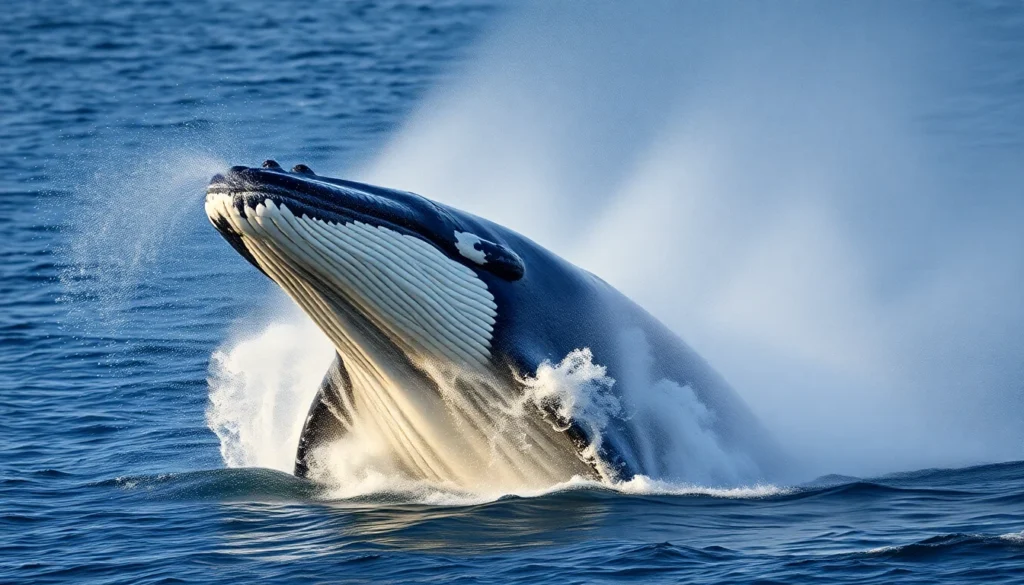
In one of the most sophisticated cooperative hunting strategies in the animal kingdom, groups of humpbacks use bubble nets to concentrate prey. Designated “bubblers” dive below a school of fish or krill and swim in a rising spiral, releasing a continuous stream of bubbles that forms a cylindrical “net” that disorients and concentrates prey. Other group members herd prey vertically with their pectoral fins while the entire group lunges upward through the center of the bubble column, mouths agape, capturing thousands of fish in a single coordinated lunge.
Migrations: The Ocean’s Greatest Journey
Humpback whales undertake the longest migrations of any mammal — traveling up to 25,000 km round-trip between polar feeding grounds and tropical breeding grounds. The North Pacific population migrates between Alaska (summer feeding) and Hawaii (winter breeding), while the Southern Hemisphere population travels between Antarctic feeding grounds and tropical breeding areas off Australia and South America. During this migration, whales fast entirely — surviving on stored blubber reserves built up during summer feeding frenzies.
Advertisement
Recovery: A Conservation Triumph
Like the blue whale, humpback whales were devastated by industrial whaling — reduced from an estimated 125,000 to fewer than 10,000 by 1966. Following a commercial whaling moratorium in 1982, humpback whale populations have recovered dramatically. The North Atlantic population has reached 80,000+ individuals; the North Pacific population approximately 21,000. The Species was downlisted from Vulnerable to Least Concern in 2008 — one of the most complete wildlife population recoveries ever documented.
Join the Conversation
Share your thoughts about the Humpback Whale